Why Most Organizations Only Think About Audits Too Late
For many organizations, audits trigger panic.
Teams scramble to locate records. Employees search through disconnected systems. Missing documents become urgent problems. Compliance officers attempt to reconstruct histories from incomplete logs and email chains.
The issue usually isn’t the audit itself.
It’s the workflow behind the documents.
Most organizations still rely on fragmented document processes that were never designed for traceability, visibility, or long-term compliance. Documents move through departments without consistent tracking. Records are stored in multiple systems. Manual handling introduces gaps that become liabilities later.
An audit-ready organization works differently.
Instead of reacting to audits after the fact, audit readiness is built directly into the document lifecycle from the moment a document enters the organization.
That’s the difference between storing documents and truly managing them.
What Does “Audit-Ready” Actually Mean?
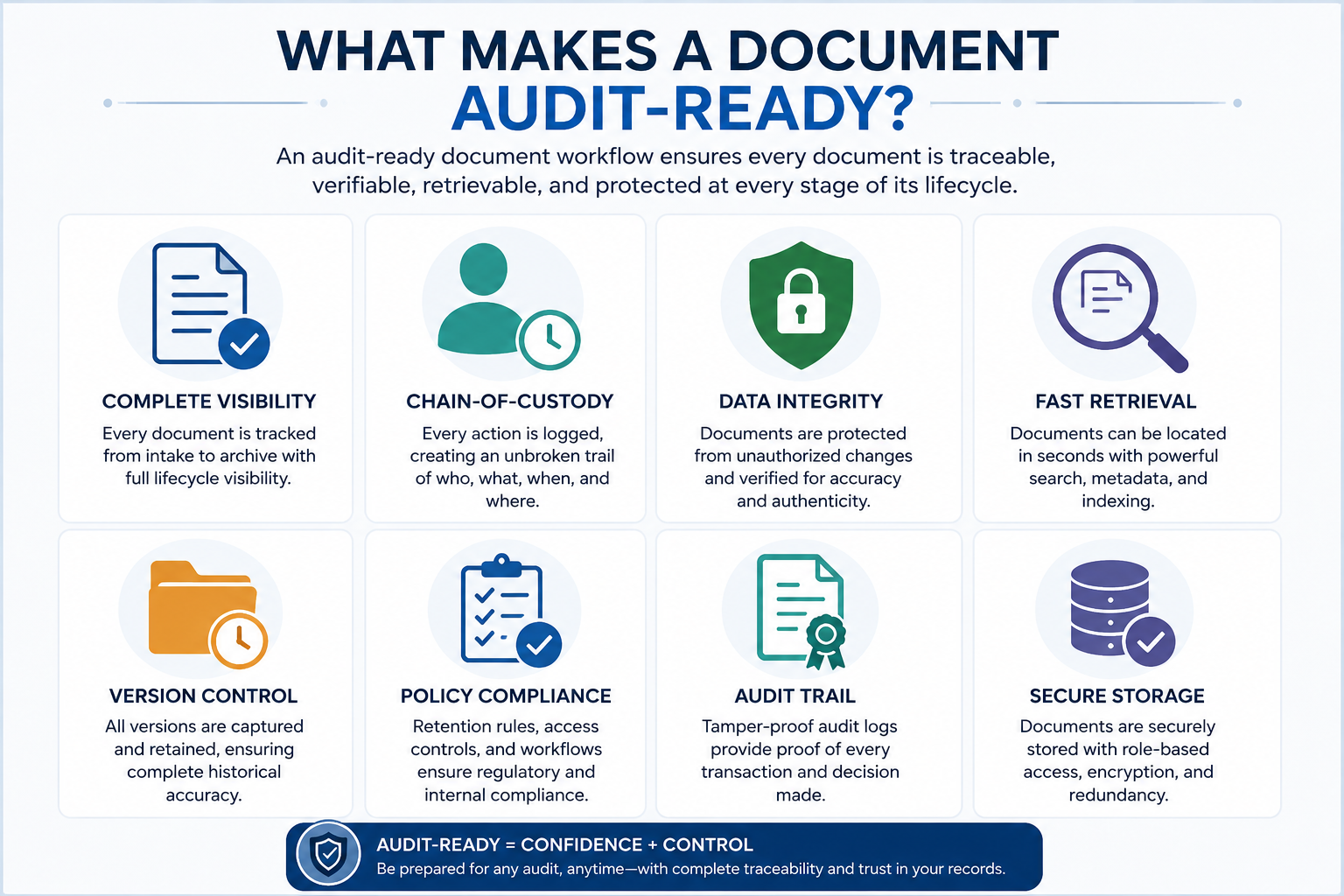
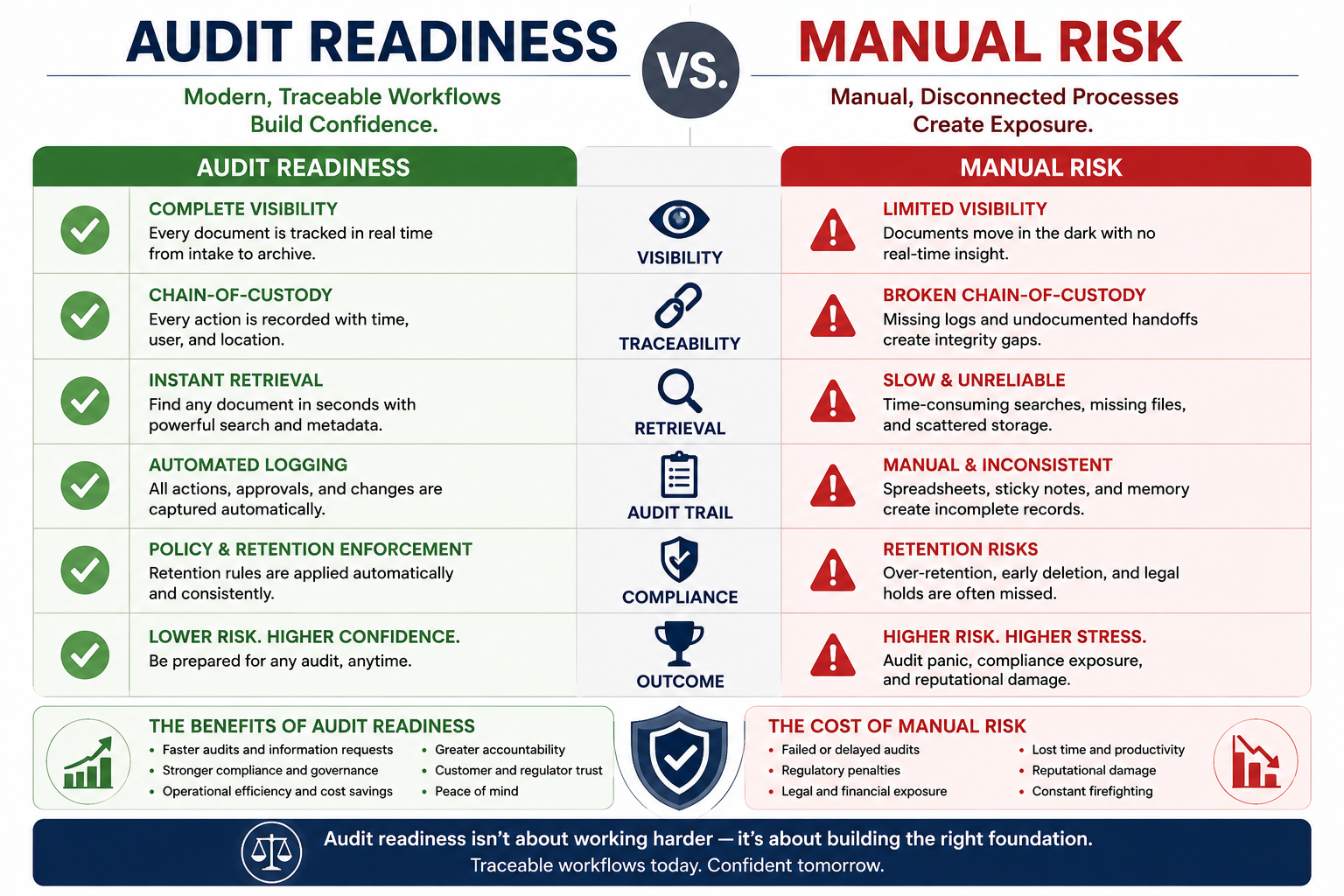
An audit-ready document workflow is one where every document can be:
-
tracked
-
verified
-
retrieved
-
validated
-
historically reviewed
at any time.
In a properly designed workflow:
-
every document has a traceable lifecycle
-
every interaction is logged
-
every workflow step is visible
-
every version is preserved
This creates operational transparency while dramatically reducing compliance risk.
Audit readiness is not limited to highly regulated industries anymore. Organizations across finance, healthcare, insurance, legal services, education, and government are now expected to maintain clear records and defensible document histories.
The 5 Biggest Gaps in Most Document Workflows
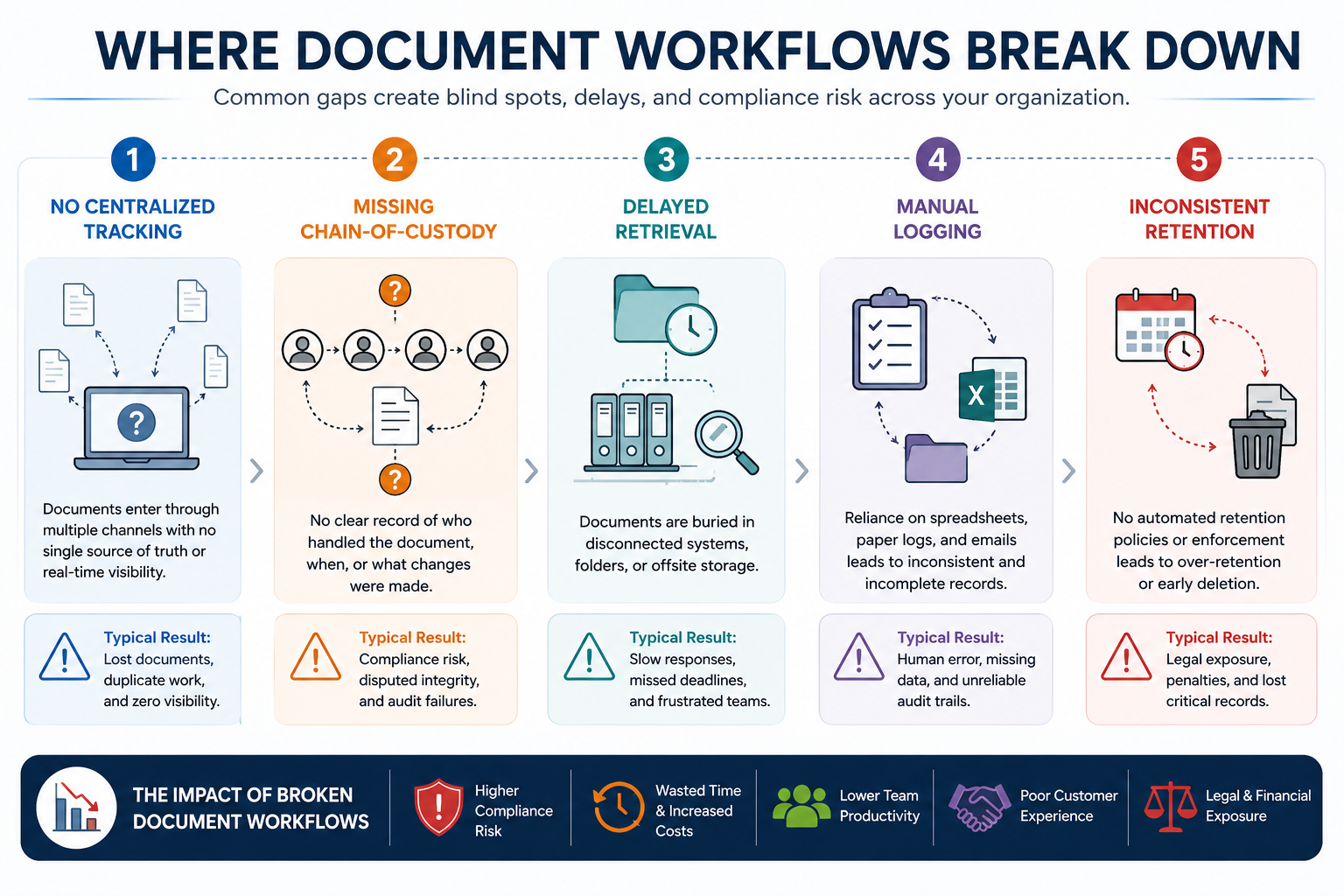
Despite increasing compliance requirements, many organizations still operate with major workflow vulnerabilities.
1. No Centralized Tracking
Documents enter the organization through multiple channels:
-
physical mail
-
email attachments
-
scanned forms
-
uploaded PDFs
Without centralized tracking, visibility disappears immediately.
Teams often cannot answer:
-
Where is the document now?
-
Who last handled it?
-
Was it approved?
-
Has it been archived?
2. Missing Chain-of-Custody Records
One of the biggest compliance risks is incomplete chain-of-custody tracking.
Organizations may know a document exists—but cannot prove:
-
who accessed it
-
when it was modified
-
where it moved
-
whether it was altered
This creates serious audit and legal vulnerabilities.
3. Delayed Retrieval
Many organizations still rely on:
-
manual file lookups
-
disconnected storage systems
-
offsite archives
Retrieving documents can take hours or days.
During audits, delays create operational stress and increase the perception of poor compliance controls.
4. Manual Logging Processes
Some organizations attempt to maintain compliance through spreadsheets, paper logs, or manual indexing.
This approach is difficult to scale and highly prone to:
-
human error
-
inconsistent entries
-
incomplete records
Manual compliance tracking eventually breaks down under volume.
5. Inconsistent Retention Policies
Without automated retention management, organizations risk:
-
keeping records too long
-
deleting records too early
-
failing to enforce legal hold requirements
Both over-retention and under-retention create legal and operational exposure.
The Anatomy of a Fully Traceable Document Workflow
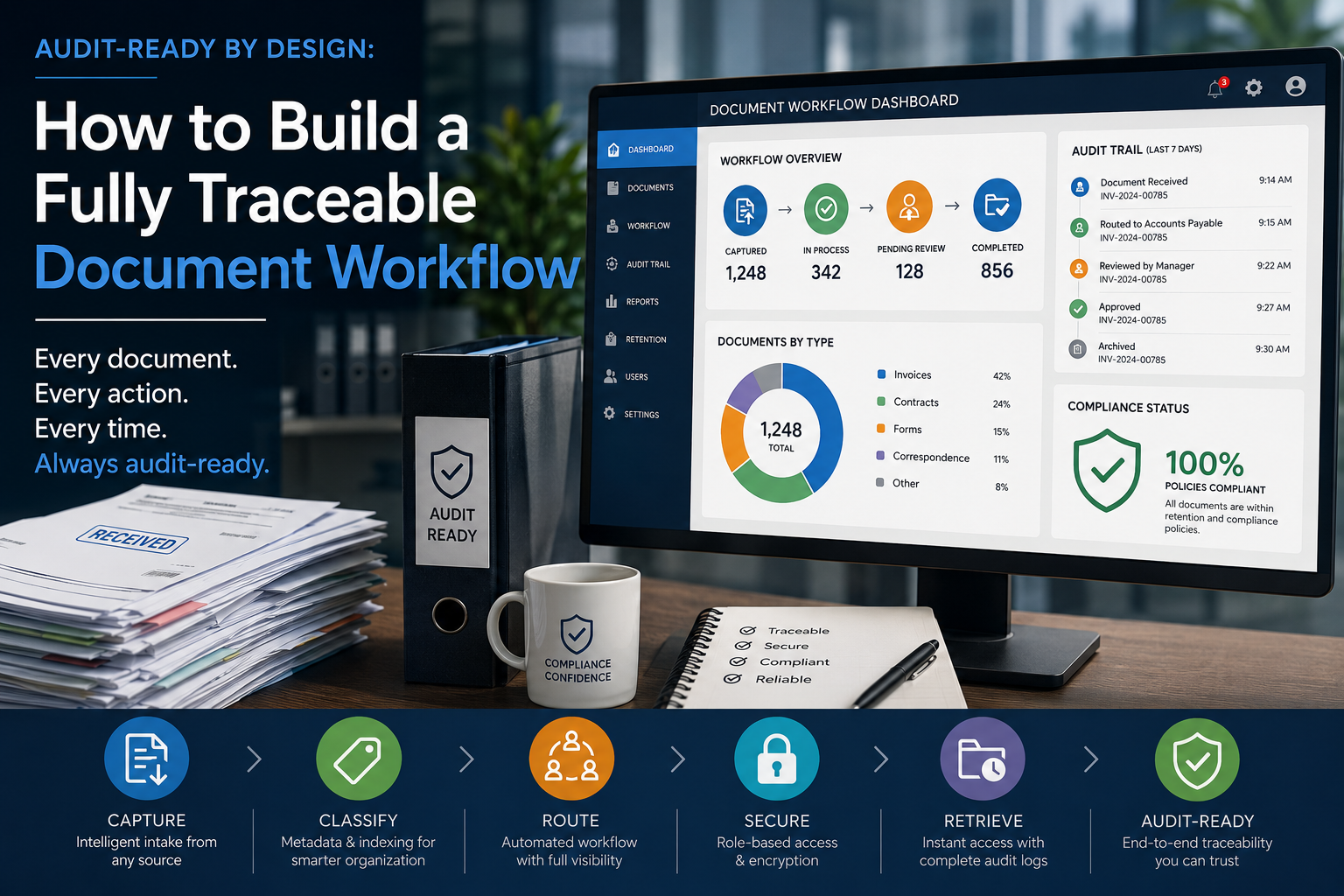
An audit-ready workflow is built around visibility at every stage.
The goal is simple:
👉 Every document should have a complete, searchable history from intake to archive.
Here’s how modern organizations achieve that.
Step 1: Capture and Assign a Tracking Identity
The process begins the moment a document enters the organization.
Whether arriving through:
-
physical mail
-
scanning stations
-
digital uploads
-
email ingestion
the document immediately receives:
-
a tracking identifier
-
timestamps
-
metadata tags
This creates the foundation for traceability.
No document should enter a workflow anonymously.
Step 2: Classification and Metadata Assignment
Once captured, documents are automatically classified based on:
-
document type
-
sender
-
department
-
workflow rules
-
business logic
Metadata makes documents:
-
searchable
-
sortable
-
retrievable
This transforms documents from static files into structured operational records.
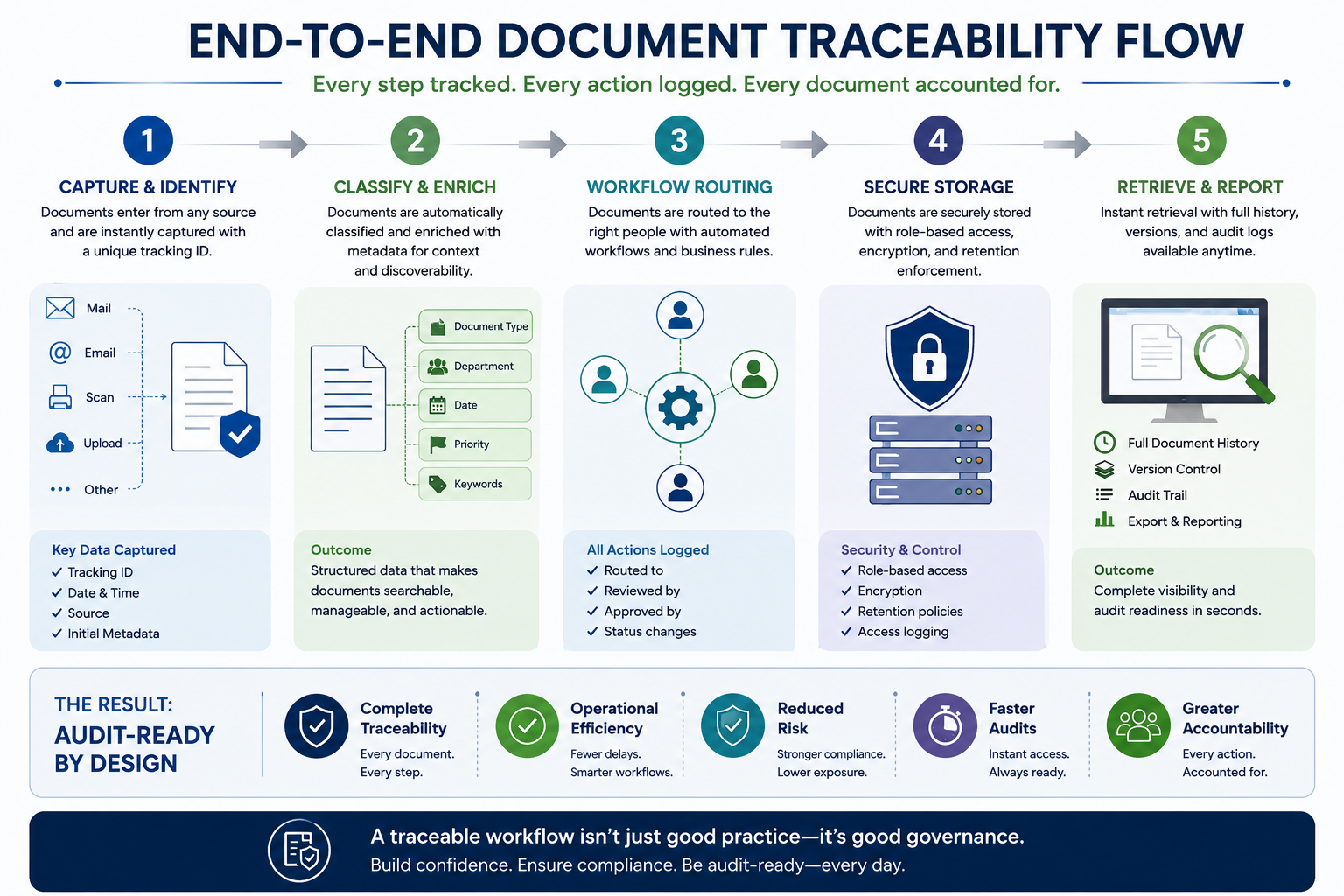
Step 3: Workflow Routing with Logged Actions
As documents move through the organization, every action is recorded.
That includes:
-
approvals
-
edits
-
routing changes
-
status updates
-
department transfers
This creates a permanent audit trail.
Modern systems eliminate uncertainty because organizations can see:
-
who touched the document
-
what changed
-
when it occurred
in real time.
Step 4: Secure Storage and Controlled Access
Audit-ready systems require more than storage capacity.
They require:
-
permission-based access
-
encryption
-
retention enforcement
-
retrieval logging
Documents should only be accessible to authorized personnel, and every access event should be recorded automatically.
Step 5: Instant Retrieval and Historical Visibility
A properly designed workflow allows organizations to retrieve:
-
current versions
-
historical versions
-
access histories
-
audit logs
within seconds.
This dramatically reduces audit preparation time and improves organizational confidence during regulatory reviews.
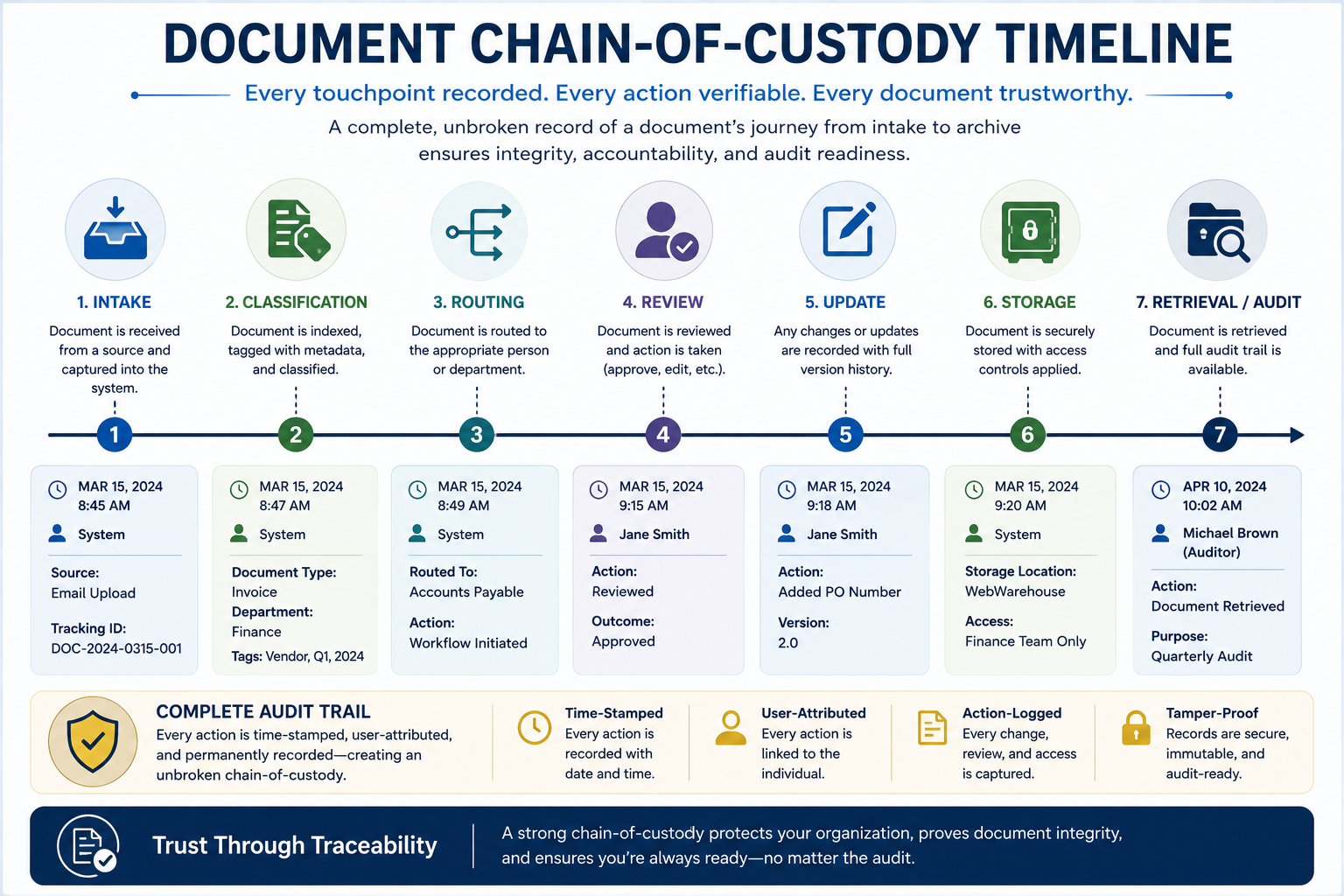
Understanding Chain-of-Custody in Document Workflows
Chain-of-custody refers to the complete documented history of a document throughout its lifecycle.
This includes:
-
where the document originated
-
who handled it
-
where it moved
-
what changes occurred
-
where it is currently stored
Chain-of-custody is especially important for:
-
financial institutions
-
healthcare providers
-
election systems
-
legal environments
-
government agencies
Without defensible chain-of-custody records, organizations may struggle to prove document integrity.
How Agissar Supports Audit-Ready Workflows
Agissar’s platforms are designed to provide visibility and traceability across the entire document lifecycle.
INFOPoll®
INFOPoll supports:
-
real-time document tracking
-
workflow validation
-
document status visibility
-
chain-of-custody transparency
Organizations gain the ability to monitor document movement from intake through processing.
WebWarehouse
WebWarehouse provides:
-
secure document storage
-
searchable retrieval
-
audit logging
-
retention policy support
Together, these systems help organizations reduce workflow blind spots while improving compliance readiness.
Real-World Operational Benefits
Organizations implementing traceable document workflows often experience significant operational improvements.
These include:
Faster Audit Preparation
Teams retrieve requested documents almost instantly.
Reduced Compliance Risk
Every workflow step is documented automatically.
Better Operational Visibility
Managers gain real-time insight into workflow bottlenecks and delays.
Improved Accountability
Every interaction is attributable and reviewable.
Enhanced Customer Service
Documents move faster through approval and response processes.
Why Audit-Ready Workflows Matter More Than Ever
Regulatory expectations continue to increase.
Organizations now face:
-
stricter data governance requirements
-
growing cybersecurity concerns
-
remote workforce challenges
-
expanding retention obligations
At the same time, audits themselves are becoming increasingly digital.
Regulators and clients now expect organizations to retrieve information quickly and demonstrate complete workflow transparency.
Organizations relying on fragmented manual systems are finding it harder to keep up.
The Future of Compliance Is Visibility
The future of compliance management is not simply about storing records.
It’s about creating workflows where every document is:
-
visible
-
traceable
-
searchable
-
secure
from beginning to end.
Organizations that invest in audit-ready systems today position themselves for:
-
lower operational risk
-
stronger compliance posture
-
faster response capabilities
-
better long-term scalability
Final Thoughts
An audit-ready workflow is not built during an audit.
It’s built every day through consistent document tracking, intelligent automation, and structured lifecycle management.
Documents should never disappear into disconnected systems or manual processes.
They should remain fully traceable from intake to archive.
As organizations continue modernizing their operations, audit-ready document workflows are quickly becoming the new standard—not just for compliance, but for operational excellence itself.
Ready to Improve Document Traceability?
Learn how Agissar’s INFOPoll® and WebWarehouse solutions help organizations create secure, fully traceable document workflows designed for compliance, visibility, and operational efficiency. Contact Agissar today!
Table of Contents
Share This!
Related Posts
Agissar not only has a history of game-changing advances in the mail extraction industry, we also have a stellar reputation for excellent products, services and attention to detail that has been built over decades. It shows in our relationships with suppliers, clients, and our ability to get excellent value for your dollar while supporting a wide range of mailing, imaging, and office products from the simple to the complex. We can custom tailor service programs to meet your needs and help you get to the top of your industry, all you need to do is contact us today!